
NHS Band 5 Nursing Reform 2026: Role Reviews, Regrading, Preceptorship & Graduate Pay – Complete Guide
Every Band 5 nurse in England will have their role reviewed in 2026. Find out if you qualify for regrading, when backpay applies, and what the new national preceptorship programme means for your career.
Every Band 5 Nurse Must Read This
Your role will be reviewed in 2026. If you’re working above Band 5 level, you could be entitled to up to £7,886/year plus backpay to April 2026. Here’s everything you need to know right now.
⚡ Key Facts — February 2026 Reform Package
- Who: Every Band 5 nurse in England
- What: Mandatory role review by employer
- When: Throughout 2026 (timescales to be confirmed)
- Backpay: If regraded, backdated to 1 April 2026
- Funding: Separate from the 3.3% pay rise
- Action needed: None yet — wait for employer contact
- Potential increase: Up to £7,886/year if regraded to Band 6 entry
⏱️ Quick Read: Every Band 5 nurse gets reviewed → If working above level → Regraded to Band 6 → Backpay to April 2026 → Up to £7,886/year increase. Document your duties now. Talk to union. Wait for employer contact.
Overview: More Than Just a Pay Rise
This is not just a pay rise year. The 2026 award is about more than just a percentage. It introduces a “fairer deal” for nurses through structural re-evaluation and a focus on graduate retention, setting a new precedent for how the NHS rewards its workforce.
On 11 February 2026, the government announced a package of four major reforms specifically targeting Band 5 nurses alongside the 3.3% pay award:
- Mandatory role reviews for every Band 5 nurse in England
- New national preceptorship programme for newly qualified nurses
- Graduate pay reform across all Agenda for Change professions
- Structural Agenda for Change reforms with backdated pay from 1 April 2026
💡 If you’re a Band 5 nurse and feel you’re working at Band 6 level without Band 6 pay — this article is specifically for you.
The Band 5 Role Review – What It Is
What Happened
For years, too many nurses have been working at a higher level without being paid fairly for it. Every Band 5 nurse will now have their role reviewed by their employer to make sure their pay and job description reflects the job they do.
Who Conducts the Review
Every Band 5 nursing role will be reviewed by employers over a set timeframe to ensure that job descriptions and pay bands reflect the work that nurses are being asked to do. This is not an optional process — it is mandatory for all NHS employers in England.
The Funding
Additional funding will be made available to support the Band 5 review process and any resulting salary uplifts. This funding is separate from the 3.3% cost of living pay award and separate from the pay structure reform discussions.
✅ What You Need to Do Right Now
Nothing. You do not need to take any action at this stage. Your employer will be in touch with you once specific timescales and deadlines for this process have been agreed nationally ahead of 1 April 2026. Employers will be required to adhere to agreed national timescales.
Will You Be Regraded? What Triggers a Band Uplift
This is the question every Band 5 nurse wants answered. Regrading is not automatic — it depends on whether your actual day-to-day duties match the responsibilities defined for Band 6 under the NHS Job Evaluation Scheme.
The Regrading Trigger
You should be regraded if your actual duties match Band 6 responsibilities under the NHS Job Evaluation Scheme, not just your job title. The review assesses what you do, not what you’re called.
Common Indicators You May Qualify
- Leading a clinical area without a Band 6 present (shift coordinator/in-charge)
- Teaching and supervising other registered nurses (not just students)
- Complex caseload management that exceeds standard Band 5 scope
- Acting up consistently in senior roles without formal recognition or pay
- Autonomous clinical decision-making beyond guided practice
- Service development or quality improvement leadership
The Backpay Rule
If you’re working above Band 5 level, you’ll be regraded and receive backpay to 1 April 2026. Extra funding has been provided specifically for this, separate from the 3.3% pay rise.
What the RCN Says
The Royal College of Nursing said Band 5 nurses relied on to practise at a Band 6 level of clinical expertise should see a pay increase. The Department of Health and Social Care conceded that too many nurses have been working at a higher level than their pay, with the RCN criticising the current role evaluation process as adversarial.
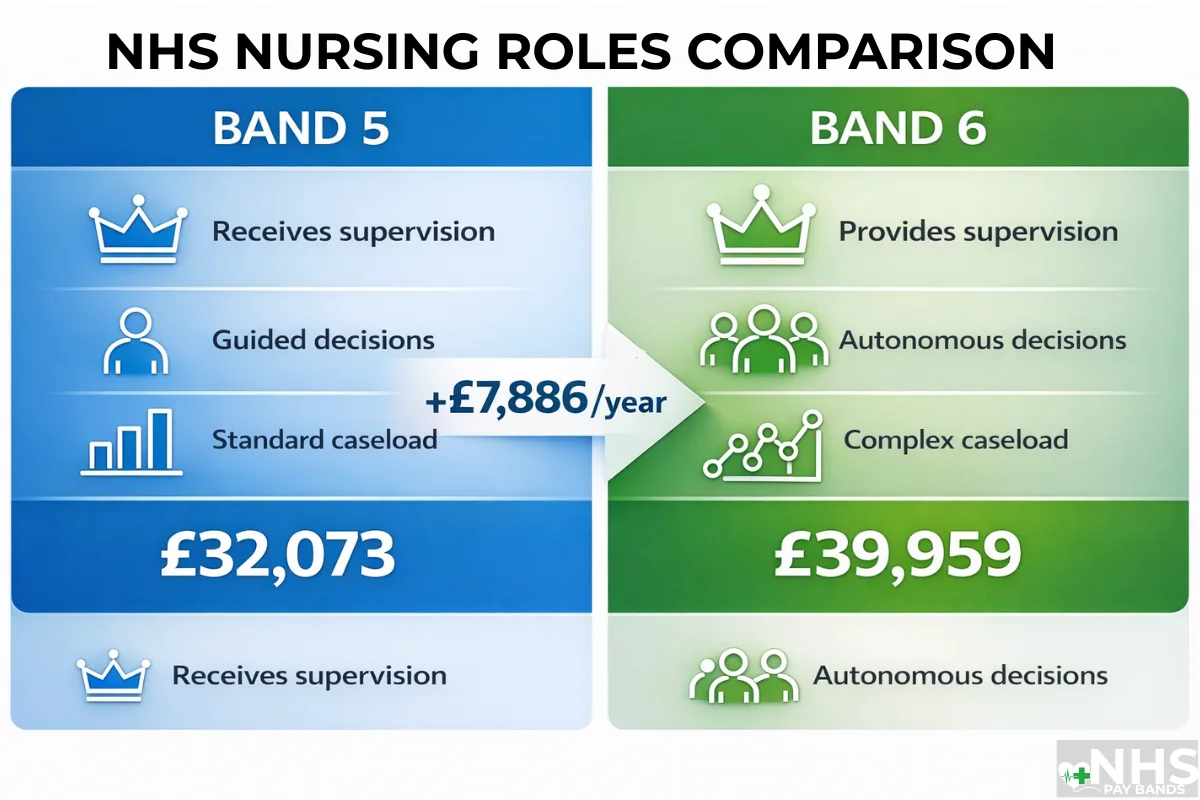
Band 5 vs Band 6 nursing responsibilities and salary comparison including leadership, supervision and autonomy differences.
Band 5 vs Band 6: Role Comparison Table
| Responsibility | Band 5 | Band 6 |
|---|---|---|
| Shift Leadership | ❌ Never | ✅ Regularly |
| Supervise Registered Nurses | ❌ No | ✅ Yes |
| Clinical Supervision | Receives supervision | Provides supervision |
| Decision-Making | Guided by protocols | Autonomous clinical decisions |
| Complex Cases | 🟡 Occasional | ✅ Regularly |
| Caseload Complexity | Standard complexity | Complex/specialist |
| Teaching Responsibility | Students & HCAs only | Registered nursing staff |
| Service Development | ❌ None | ✅ Lead Projects |
| Management Duties | None | Team leadership |
| Annual Salary 2026/27 | £32,073–£39,043 | £39,959–£48,118 |
| Potential Annual Increase | — | Up to +£7,886 |
Note: If regraded from Band 5 entry (£32,073) to Band 6 entry (£39,959), the annual increase is £7,886 before tax and deductions. Monthly gross increase: approximately £657/month (≈£450-500 net).
💷 Calculate Your Potential Pay Increase
See exactly what you could earn if regraded to Band 6:
Current (Band 5 Entry)
£32,073
£2,673/month gross
≈£2,150/month net
If Regraded (Band 6 Entry)
£39,959
£3,330/month gross
≈£2,600/month net
Annual Increase: £7,886 | Monthly: +£657 gross (+£450 net)
Real-World Examples: Who Will Benefit?
Here are three realistic scenarios showing how the Band 5 review will affect different nurses:
Case Study 1: Sarah, A&E Staff Nurse
Current situation: Band 5, step 3 (£34,381), 4 years experience
Role reality: Regularly coordinates shifts when senior nurses unavailable, supervises newly qualified nurses, manages complex trauma cases independently, teaches student nurses and provides clinical guidance to HCAs.
Review outcome: Matches Band 6 criteria — will be regraded
Financial impact:
- New salary: Band 6 entry point £39,959
- Annual increase: £5,578
- Backpay (April-September, if review completes in September): £2,789 lump sum
- Monthly increase: £465 gross (≈£330 net)
- Over 20-year career: £111,560 extra earnings
“I’ve been doing this work for two years without recognition. Finally being paid fairly will make a huge difference to my family.” — Sarah’s reaction
Case Study 2: James, Mental Health Nurse
Current situation: Band 5, step 2 (£33,024), 2 years experience
Role reality: Works within standard Band 5 scope with appropriate clinical supervision, manages standard caseload, does not lead clinical areas or supervise other registered nurses. Receives regular supervision from Band 6 colleagues.
Review outcome: Correctly banded at Band 5 — no change from review
Financial impact:
- Remains Band 5 (appropriate for current duties)
- Receives 3.3% pay rise: £33,024 → £34,114
- Annual increase from pay rise: £1,090
- Will benefit from future graduate pay reform when agreed
- Can progress through Band 5 increments to £39,043
Note: James will still benefit from the graduate pay reform being negotiated by the NHS Staff Council, which will increase starting pay for all graduate professions.
Case Study 3: Aisha, Community Nurse
Current situation: Band 5, top of scale (£39,043), 8 years experience
Role reality: Manages complex caseload independently, supervises and mentors junior community nurses, leads service improvement projects, makes autonomous clinical decisions daily, coordinates care across multiple agencies.
Review outcome: Clearly matches Band 6 criteria — will be regraded
Financial impact:
- New salary: Band 6 step 2 (£42,121 — matches years of experience)
- Annual increase: £3,078
- Backpay (April-December, if review completes December): £2,309 lump sum
- Monthly increase: £257 gross (≈£180 net)
- Career progression unlocked: Can now progress to Band 6 top (£48,118)
“I’ve been stuck at the top of Band 5 for three years doing Band 6 work. This recognition means I can finally progress in my career.” — Aisha’s reaction
Key Pattern Across All Case Studies
The determining factor is what you actually do, not your job title or years of service. If your day-to-day duties match Band 6 responsibilities (supervision, autonomy, complexity, leadership), you’ll be regraded regardless of your current pay step. If you work within standard Band 5 scope, you’ll remain Band 5 but still benefit from the 3.3% rise and future graduate pay reforms.
National Preceptorship Programme
The Problem It Solves
Too few nurses are currently benefitting from structured career support right from their first graduate role. There is currently no universal preceptorship programme in place for new graduate nurses across England, leading to inconsistent support and early career attrition.
What’s Being Created
The Chief Nursing Officer for England will lead work with unions, employers and stakeholders to improve the quality and consistency of preceptorships — 1-to-1 support programmes which give newly qualified nurses the best possible start to their career — across the country.
Who Leads It
Led by England’s Chief Nursing Officer Duncan Burton, this will standardise support, improve retention, and build clinical confidence across all NHS trusts.
Timeline
The Chief Nursing Officer for England will lead this work as part of the upcoming professional strategy for nursing to improve the quality and consistency of preceptorships for all newly qualified nurses. This work will be delivered in partnership with trade unions, employers and other key stakeholders.
Why This Matters
- Inconsistent preceptorship has been cited as a major driver of early career attrition
- New nurses without structured support are more likely to leave within 3 years
- Standardised support = better retention = stronger staffing levels
- Currently, preceptorship quality varies wildly between trusts — some excellent, others non-existent
What This Means for Newly Qualified Nurses
If you’re a newly qualified nurse or about to graduate, you’ll benefit from consistent, high-quality support regardless of which trust you join. This should significantly improve your transition from student to registered nurse and reduce the “reality shock” many new nurses experience.
Graduate Pay Reform (Broader Than Just Nurses)
Scope — All Graduate Professions Benefit
One of the conditions of the reform package is that pay for all graduates should be increased, with the NHS Staff Council deciding the level of uplift. This will not only benefit graduate nurses, but also other vital NHS professions such as occupational therapists, pharmacists, physiotherapists, speech and language therapists, paramedics, and more.
The Negotiation Mechanism
The Secretary of State will ask the NHS Staff Council to prioritise graduate pay as part of these reforms. It will be for the NHS Staff Council to negotiate the specific changes to graduate pay. This means the exact amount and structure is still being determined.
Why It Matters
For the NHS to deliver the standards of care patients need, nursing and other healthcare roles must become more attractive options as graduate professions. Competitive starting salaries are essential for recruitment and retention.
Professions Affected by Graduate Pay Reform
| Profession | Current Entry Pay (Band 5) | Reform Status |
|---|---|---|
| Nurses (Band 5) | £32,073 | ✅ Included |
| Occupational Therapists | £32,073 | ✅ Included |
| Pharmacists | £32,073 | ✅ Included |
| Speech & Language Therapists | £32,073 | ✅ Included |
| Physiotherapists | £32,073 | ✅ Included |
| Paramedics | £32,073 | ✅ Included |
| Dietitians | £32,073 | ✅ Included |
| Radiographers | £32,073 | ✅ Included |
| Podiatrists | £32,073 | ✅ Included |
| Operating Department Practitioners | £32,073 | ✅ Included |
Structural Agenda for Change Reform — The Bigger Picture
What’s Being Negotiated
Key priorities in the structural reform negotiations include:
- Raising pay for the lowest bands (Bands 2-4)
- Improving graduate pay across all professions
- Better starting salaries for newly qualified nurses, pharmacists, OTs and other graduates
- Updated job evaluation ensuring pay bands reflect modern nursing and healthcare roles
- Addressing pay compression between bands
The Critical Backpay Promise
💰 Important: Backdated Pay Guarantee
Once structural reforms are agreed, the additional pay increases will be backdated to 1 April 2026. This means staff won’t lose out while negotiations continue and any agreed improvements apply from the start of the financial year.
Timeline of Negotiations
The NHS pay rise 2026 is not the end of discussions about pay reform. Official communications indicate that further work will continue on structural changes and engagement with unions throughout 2026. The Government has committed to working with the NHS Staff Council to invest in reforming the Agenda for Change pay structure.
This means there may be additional pay increases beyond the 3.3% award and Band 5 regrading once these reforms are finalized — all backdated to 1 April 2026.
Trade Union Reactions — The Full Picture
Royal College of Nursing (RCN)
Professor Nicola Ranger, RCN General Secretary and Chief Executive, said:
“Today’s announcement is significant progress on career progression for nursing staff. Too many
are not being paid fairly and valued for their skills and responsibilities in caring for patients,
too often starting and finishing their careers on the same low pay band. It is the first time
nursing has been prioritised in this way.”
However, on the 3.3% pay award itself:
Nicola Ranger also said:
“A pay award below the current level of inflation is an insult. Unless inflation falls, the
government is forcing a very real pay cut on its NHS workers.”
Context: The RCN welcomed the Band 5 reforms and preceptorship programme as major victories but maintained criticism of the 3.3% pay award as insufficient given inflation.
UNISON
UNISON welcomed the preceptorship programme as “long overdue” but said staff were “downright angry” about the 3.3% pay award, which they argue does not adequately compensate for years of real-terms pay cuts. The union has called for urgent action on structural reforms and expedited Band 5 reviews.
GMB
Rachel Harrison, GMB national officer, said:
“GMB welcomes this commitment to recognising the value of the nursing workforce across the NHS.
Hard-working staff should get paid appropriately and fairly for the work they do.”
Unite the Union
Unite described the 3.3% award as insufficient, particularly given current inflation levels, but acknowledged the role review and preceptorship commitments as “steps in the right direction.” The union emphasized that much more needs to be done to restore NHS pay to 2010 levels in real terms.
✅ TL;DR Union Position: All major unions welcomed Band 5 reforms and preceptorship but criticized the 3.3% pay rise as too low. The consensus: reforms are progress but more needed on base pay.
Key Dates & Timeline
| Date | Event |
|---|---|
| 11 February 2026 | Government announces Band 5 reform package with RCN |
| 12 February 2026 | 3.3% pay rise confirmed. Structural reforms committed |
| From now | Employers begin preparing for Band 5 role reviews. National timescales to be agreed |
| 1 April 2026 | 3.3% pay rise takes effect. Backpay reference date for all reforms |
| End of April 2026 | First pay packet with new rate (first on-time payment in 6 years) |
| Throughout 2026 | Band 5 role reviews conducted by employers (national timescales to be confirmed) |
| 2026 ongoing | AfC structural reform negotiations with NHS Staff Council |
| TBC 2026 | Additional pay increases from structural reforms agreed — backdated to 1 April |
| Summer 2026 | 2027/28 pay remit letters expected from government |
What You Should Do RIGHT NOW
Here are practical steps Band 5 nurses should take to prepare for the role review process:
-
✅ Check your job description
Review your current job description and compare it to what you actually do day-to-day. Note any discrepancies between what’s written and your actual duties. Request a copy from your line manager or HR if you don’t have one. -
📝 Keep a detailed record
Document duties that exceed standard Band 5 scope over the next few months. Include: dates you’ve led shifts, examples of supervising registered staff, complex cases you’ve managed independently, teaching or mentoring you’ve provided, service improvement work you’ve led. Keep this in a notebook or digital file. -
🤝 Talk to your union representative
RCN, UNISON, Unite, and GMB all have guidance on the review process. Book a meeting with your rep to discuss your role and potential regrading. They can help you understand the NHS Job Evaluation Scheme and what evidence you’ll need. -
🚫 Don’t contact your employer yet
National timescales will be set and communicated. Your employer will contact you when the process begins. Jumping the gun may cause confusion or create administrative issues. Wait for the official process to start. -
🔄 Update your union details
If you’re an RCN member, the union specifically asked members to confirm their band details on MyRCN to facilitate the review process. Log in and check your membership record is accurate. -
💷 Calculate your potential uplift
If regraded from Band 5 entry (£32,073) to Band 6 entry (£39,959), your annual increase would be £7,886 (approximately £657/month gross, or £450-500/month net after tax and deductions). Use our calculator to see your exact take-home pay at different bands. -
📚 Familiarize yourself with Band 6 criteria
Read the NHS Job Evaluation Scheme handbook (available from your trust or online). Understand what Band 6 responsibilities look like. Be honest with yourself — do you regularly perform these duties? -
💬 Discuss with colleagues
Talk to other Band 5 nurses in your department. Are they experiencing the same? Collective experiences can help strengthen cases and ensure consistency. However, remember each person’s review will be individual.
💡 Pro tip: Use our NHS Pay Calculator to see exactly what your take-home pay would be at Band 6, factoring in tax, NI, pension and any student loan deductions. Understanding the financial impact can help you prepare for potential changes to your household budget.
Frequently Asked Questions
Q: Does this apply to all Band 5 clinical roles or just nurses?
A: The mandatory role review is specifically for Band 5 nurses. However, the graduate pay reform and AfC structural reform discussions cover all graduate professionals on AfC contracts, including AHPs, paramedics, pharmacists and more. If you’re a Band 5 physiotherapist, OT, pharmacist etc., you won’t get the mandatory review but will benefit from graduate pay reforms when agreed.
Q: What if I’m a Band 5 nurse in a GP practice?
A: Most practice nurses employed directly by GP surgeries are not on Agenda for Change contracts and this announcement does not apply to them. Practice nurse pay is typically covered by separate recommendations from the Review Body on Doctors’ and Dentists’ Remuneration (DDRB). Check with your employer if you’re unsure about your contract type.
Q: Does this apply in Scotland, Wales and Northern Ireland?
A: The Band 5 role review and nursing support package is specific to England. Wales also received the 3.3% pay award. Scotland has its own negotiating arrangements with separate timescales and processes. Northern Ireland is still confirming 2026/27 implementation. If you work in Scotland, Wales or NI, check with your local health board or union for region-specific information.
Q: When will the reviews actually happen?
A: Band 5 role reviews will start in 2026 once national timescales are agreed. Employers will be required to adhere to agreed national timescales. There will be further details about these ahead of 1 April 2026. You do not need to take any action at this stage. The exact timeline will likely be announced in March 2026 once unions and NHS Employers finalize the process framework.
Q: If I get regraded, when will I see the money?
A: Any regrading resulting from the review comes with backpay to 1 April 2026, funded separately from the 3.3% pay award. The exact timing of payment depends on when your individual review completes. For example, if your review is finalized in September 2026, you’ll receive 6 months of backpay (April-September) as a lump sum, then the new higher salary going forward.
Q: Will I automatically get regraded just because I’m Band 5?
A: No. Regrading is not automatic. Your employer will review your actual duties against the NHS Job Evaluation Scheme. If your role matches Band 6 responsibilities (leadership, supervision, autonomy, complexity), you’ll be regraded. If your duties are appropriately banded at 5, you’ll remain Band 5 but still get the 3.3% rise and benefit from future graduate pay reforms.
Q: What if I disagree with my review outcome?
A: There will be an appeals process. Specific details will be provided when national timescales and procedures are confirmed. Your union can support you through the appeals process if needed. The appeals process will likely mirror existing NHS job evaluation appeals procedures, with an independent panel reviewing your case.
Q: How much backpay will I get if regraded?
A: If regraded from Band 5 entry (£32,073) to Band 6 entry (£39,959) on 1 April 2026, and your review completes in September 2026 (6 months later), you would receive approximately £3,943 in gross backpay (half of the £7,886 annual difference). The exact amount depends on your current step, the step you’re moved to, and when your review completes. Remember this will be taxed as normal income.
Q: I’m currently acting up as Band 6. Will this affect my review?
A: If you’re formally acting up in a Band 6 role, your substantive Band 5 post will still be reviewed. If the review shows your substantive duties match Band 6, you should be permanently regraded. This could mean you stop “acting up” and become Band 6 in your substantive post. Discuss this with your line manager and union rep.
Q: What if I work part-time?
A: Part-time staff will be reviewed in exactly the same way as full-time staff. The review looks at the responsibilities and complexity of your role, not the hours you work. If you perform Band 6 duties part-time, you should be regraded to Band 6 part-time. Your salary will be pro-rata but your band should reflect your responsibilities.
🎯 Key Takeaways
- Every Band 5 nurse in England will have their role reviewed in 2026
- If working above Band 5 level, you’ll be regraded with backpay to 1 April 2026
- Funding for regrading is separate from the 3.3% pay rise
- Potential increase: up to £7,886/year if moved from Band 5 to Band 6 entry
- National preceptorship programme will standardise support for newly qualified nurses
- Graduate pay reform covers all AfC professions, not just nursing
- Structural AfC reforms will be backdated to 1 April 2026
- You don’t need to do anything yet — wait for employer contact
- Document your duties and talk to your union rep to prepare
- The review assesses what you actually do, not your job title
Calculate Your Potential New Salary
See exactly what you’d earn at Band 6 with our free NHS Pay Calculator.
Includes tax, National Insurance, pension, and student loan deductions.